

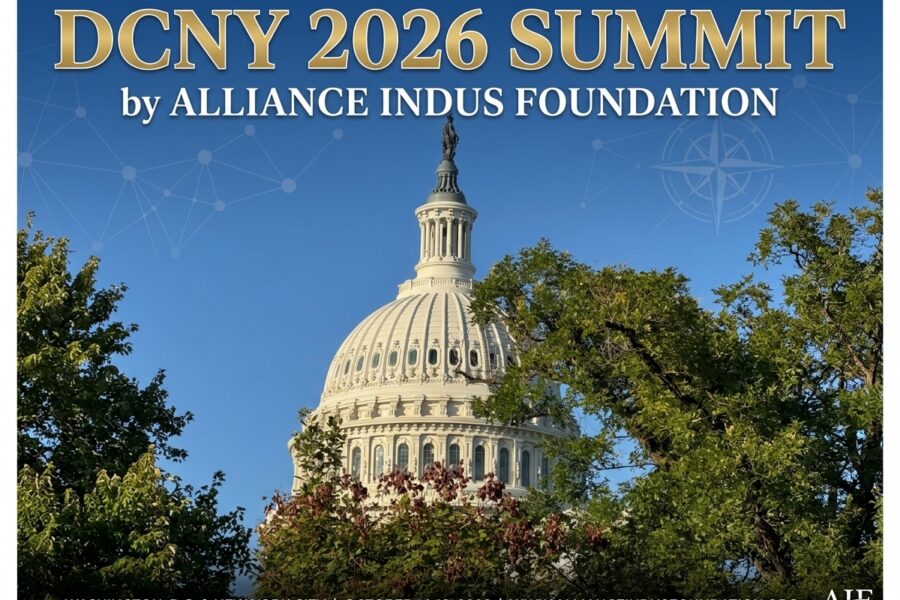

NextStar Venture Partners Managing Director Deborah Magid recently returned from Washington, D.C., where she spoke at the AI-themed DCNY Summit at the Rayburn House Office Building on September 16, 2026. The summit, hosted by the Alliance Indus Foundation, brought together a notably diverse room, and it left her thinking about how much the conversation around AI has changed.
For the DCNY Summit, Deborah had arranged a fireside chat with Yan Zheng of In-Q-Tel, while admittedly having very little idea what to expect from the program itself. What she found was an attentive audience of more than 150 current and former leaders spanning business, investing, entrepreneurship, diplomacy, and politics.
A Room That Reflected the Moment
The breadth of the room was striking. Guests making remarks included diplomats representing Montenegro, Fiji, Nepal, Zimbabwe, Bangladesh, Georgia, and Estonia. Members of Congress who joined included Brad Sherman and Mark Takano of California, Raja Krishnamoorthi of Illinois, and Shri Thanedar of Michigan. Deborah appreciated their taking the time to engage directly with the gathering and its discussions.
The program featured a range of panels along with a fireside chat with Reta Jo Lewis, attorney and former Chair and President of the Export-Import Bank of the United States, who spoke passionately about the need for collaboration across boundaries: states, agencies, institutions, and countries. It was a theme that ran through the entire day.
And, not surprisingly, AI was everywhere.
So What Has Actually Changed?
That ubiquity is what Deborah keeps returning to. AI has been a topic of serious interest in the venture capital and startup communities for well over a decade. So what has changed to bring it into a room full of diplomats and members of Congress?
The answer is that AI is no longer primarily a conversation among technologists, researchers, investors, and startups. Generative AI, and now agentic AI, has brought both extraordinary new capabilities and very real concerns directly into people’s daily work and lives. It has become a conversation for everyone.
The data confirms just how quickly that shift has happened. According to the Pew Research Center’s “Americans and AI 2026” report, published in June 2026, roughly half of U.S. adults now use AI chatbots, up from less than a quarter in 2023. In the span of three years, a technology that lived largely in specialist circles has become a fixture of ordinary life. When half a population is using something directly, it stops being a niche technical subject and becomes a matter of broad public concern, which is exactly how it ends up on the agenda in a congressional office building.
That is why the debates around guardrails, governance, data centers, global standards, security, and responsible innovation have become so urgent, and at times so passionate. These are no longer abstract questions for a handful of experts. They touch how people work, how institutions function, and how nations relate to one another.
Why Collaboration Is the Only Path Forward
The DCNY Summit shone a light on those debates, and Deborah left hopeful that it also helped advance the collaborations that will be necessary to address them. That, ultimately, is the throughline that connects a room of diplomats, legislators, investors, and founders.
The future of AI will not be shaped by any one company, sector, institution, or country. It is too consequential and too widely distributed for that. Getting it right will require exactly the kind of cross-boundary cooperation that Reta Jo Lewis described, and that the diversity of the room itself embodied. At NextStar, this is core to how we think about investing in AI for critical industries. The technologies that will earn lasting trust are the ones built with an awareness that they operate inside a broader system of institutions, regulations, and human stakes that no single actor controls.
We need to keep working across those boundaries to advance innovations that make AI both transformational and safe. The DCNY Summit at the Rayburn House Office Building was a reminder that the will to do that work exists, and that the conversation, now genuinely everyone’s, is well underway.