

The Founder Is the Catalyst: Why We Invest in People First

For many years, I have had the privilege of working at the heart of the entrepreneurial ecosystem. Through venture firms, on boards, and alongside founders building ambitious companies, I have watched what separates the ideas that endure from the ones that fade. That vantage point is a large part of why we built NextStar Venture Partners, and it shapes how we think about every company we consider backing.
There is a temptation, particularly in an industry defined by artificial intelligence, to believe that the technology is the thesis. Faster models, novel architectures, proprietary datasets. These things matter enormously, and they are often what first draws attention to a company. But they are not, in the end, what we are betting on when we write a check at the seed or Series A stage. The technology will change. The markets will evolve. The competitive landscape that looks settled today will look entirely different in eighteen months. What we are underwriting is something more durable than any of it. We are betting on the people.
The Evidence Backs the Instinct
This is not merely a matter of conviction or sentiment. It is one of the most consistent findings in the study of how venture capital actually works. The most comprehensive survey of venture capitalists conducted to date, published in the Harvard Business Review by Gompers et al., found that 95 percent of respondents cited the team as an essential factor in the investment decision. Nearly half identified it as the single most important factor, outweighing the product, the business model, and the market combined.
The same research surfaced something even more telling. When those investors were asked what had actually driven the outcomes of their past investments, the team was the dominant factor in both directions. It was cited in 96 percent of their successes and 92 percent of their failures. The people, in other words, are not just what investors screen for at the outset. They are what determines how the story ends.
The reason becomes obvious once you have watched enough companies move from formation to scale. A brilliant product in the hands of a team that cannot navigate adversity will stall. A more modest starting idea in the hands of founders with judgment, resilience, and integrity will adapt, iterate, and often arrive somewhere far more valuable than where they began. The company that gets funded is rarely the company that ultimately succeeds. What carries a startup across that distance is the founder, the catalyst who turns shifting inputs, new technology, new markets, new constraints, into something that lasts.
What We Actually Look For
The specific companies will vary. The sectors we invest in, including health, energy, agriculture, advanced manufacturing, and cybersecurity, each demand different technical expertise and face different market dynamics. But the qualities we look for in the founders building them do not change from one deal to the next.
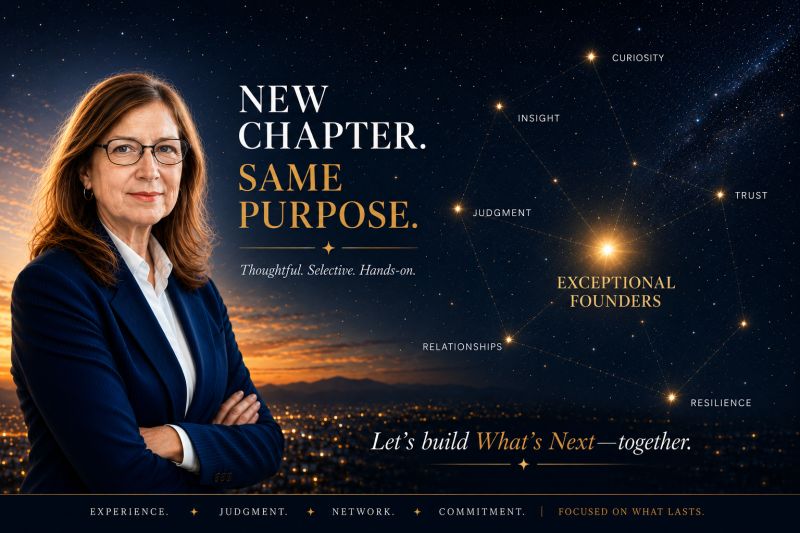
We look for curiosity, the kind that keeps a founder learning faster than the market moves. We look for insight, the ability to see something true about a problem that others have missed. We look for judgment, because the number of consequential decisions a founder makes in the early years is staggering, and no investor can make them on the founder’s behalf. We look for relationships, because enduring companies are built by people others want to work with, sell to, and believe in. We look for resilience, because the path is never linear and the founders who survive are the ones who can absorb setbacks without losing conviction. And above all, we look for trust, because everything else depends on it.
Why This Matters More in the Age of AI, Not Less
It might seem that in an era of extraordinary technological acceleration, the human element would matter less. The opposite is true. When the underlying technology is advancing this quickly, the durable advantage is not the model a company builds today, which may well be surpassed within a year. It is the team’s capacity to keep building, to keep learning, and to keep earning trust as the ground shifts beneath them.
For founders operating in critical industries, that capacity is not optional. These are sectors where the stakes are high, the buyers are demanding, and the margin for error is thin. A hospital, a utility, or a manufacturer does not extend the benefit of the doubt to an unproven vendor, nor should it. The founders who succeed in these markets are not simply strong technologists. They are people of exceptional judgment and integrity who understand that trust, once earned, is the most defensible asset a company can hold.
At NextStar, we invest in AI. But we have never been in the business of betting on technology alone. We are in the business of backing exceptional people who use technology to build things that last. The models will keep improving. The markets will keep turning over. The founders with curiosity, resilience, and integrity are the ones who will still be standing when they do.
That has always been the constant. It always will be.