



Everyone Wants to Be in “The Room.” What Does That Tell Us?
Within the past year, I have become convinced that LinkedIn has a new favorite word.
It is not AI. It is not agentic. It is “the room.”
The first time I heard it, I thought it was a wonderful metaphor. Vivid, human, and exactly the right size for the idea it carried. By the hundredth time, I had started to wonder why so many people had independently converged on precisely the same image.
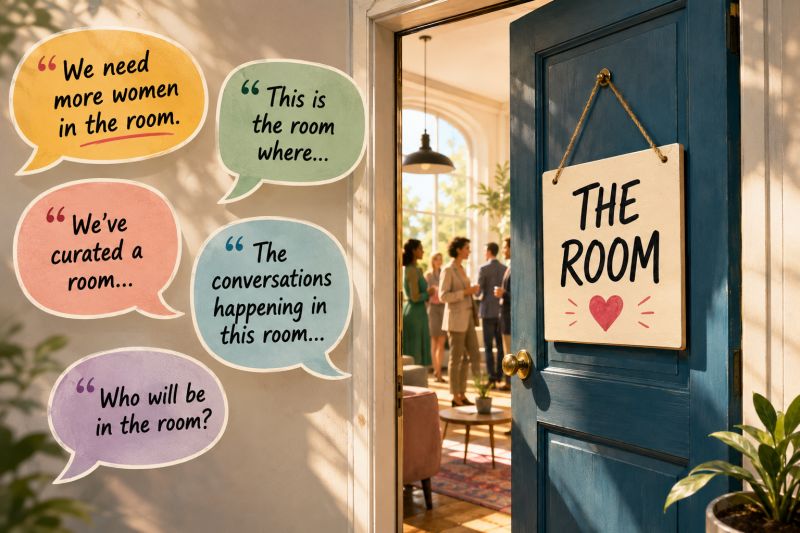
“We need more women in the room.”
“This is the room where it happens.”
“We have curated a room of remarkable people.”
“The conversations happening in this room are extraordinary.”
“Who will be in the room?”
A few years ago, we talked about ecosystems. Then it was networks. Then communities. Now, everywhere I look, it is the room.
What a Word Choice Reveals

Language tells us what a culture values, and I suspect this particular shift says something worth noticing. The room is a metaphor for access, influence, and belonging. It compresses an entire cluster of ideas into a single image: the people making the decisions, the conversations that actually matter, the physical place where opportunity is created and distributed. In three words, it draws a line between inside and outside.
That is almost certainly why it spread so quickly. The best metaphors do a great deal of work in very little space, and the room does exactly that. It flatters the speaker and the listener at once. To invoke the room is to suggest that you know where it is, and perhaps that you can get someone else into it.
This is not a new observation about language, though it is one worth revisiting. In a recent Harvard Business Review conversation on what workplace jargon reveals about company culture, a linguist made the point that the specific words an industry adopts are rarely accidental. They signal what that culture prizes, what it rewards, and what it quietly uses to sort people into categories. Buzzwords are not just lazy shorthand. They are a window into the values of the people using them.
When a Metaphor Becomes a Badge
Here is the difficulty with a successful metaphor. The very popularity that proves its usefulness eventually hollows it out. The first time you hear the room, you picture something specific. By the fiftieth time, you picture nothing at all. The words have stopped conjuring an image and started functioning as a verbal badge, a small signal of status and belonging that says less about any actual room and more about the speaker’s desire to be seen as someone who belongs in one.
That transformation, from vivid image to empty credential, is the natural life cycle of nearly every buzzword. Synergy went through it. Disruption went through it. So did ecosystem, network, and community, the very words the room replaced. Give it two years and something new will take its place, and we will all wonder how we ever managed to talk about influence without it.
Why This Matters in Our World
In venture capital, and especially in the corner of it focused on AI, language moves fast and carries real weight. The words we use to describe founders, funding rounds, and opportunities shape how capital flows and how people understand their own position within the industry. That makes it worth staying alert to the gap between what a phrase sounds like and what it actually means.
At NextStar, we try to be deliberate about this. It is easy, in a field this fashionable, to let the vocabulary do the thinking. But the substance of what we do, backing exceptional founders building AI for critical industries, does not fit neatly into whatever metaphor happens to be circulating this quarter. The work is specific, and it deserves specific language. When everyone in an industry starts describing their value the same way, using the same borrowed image, that is usually the moment the image has stopped meaning much of anything.
So I will keep noticing the room, the way you cannot unsee a word once you have started counting it. And I will keep trying to say what I actually mean instead.
Now that I have confessed mine, I am curious about yours. What is the phrase you have suddenly started hearing everywhere?